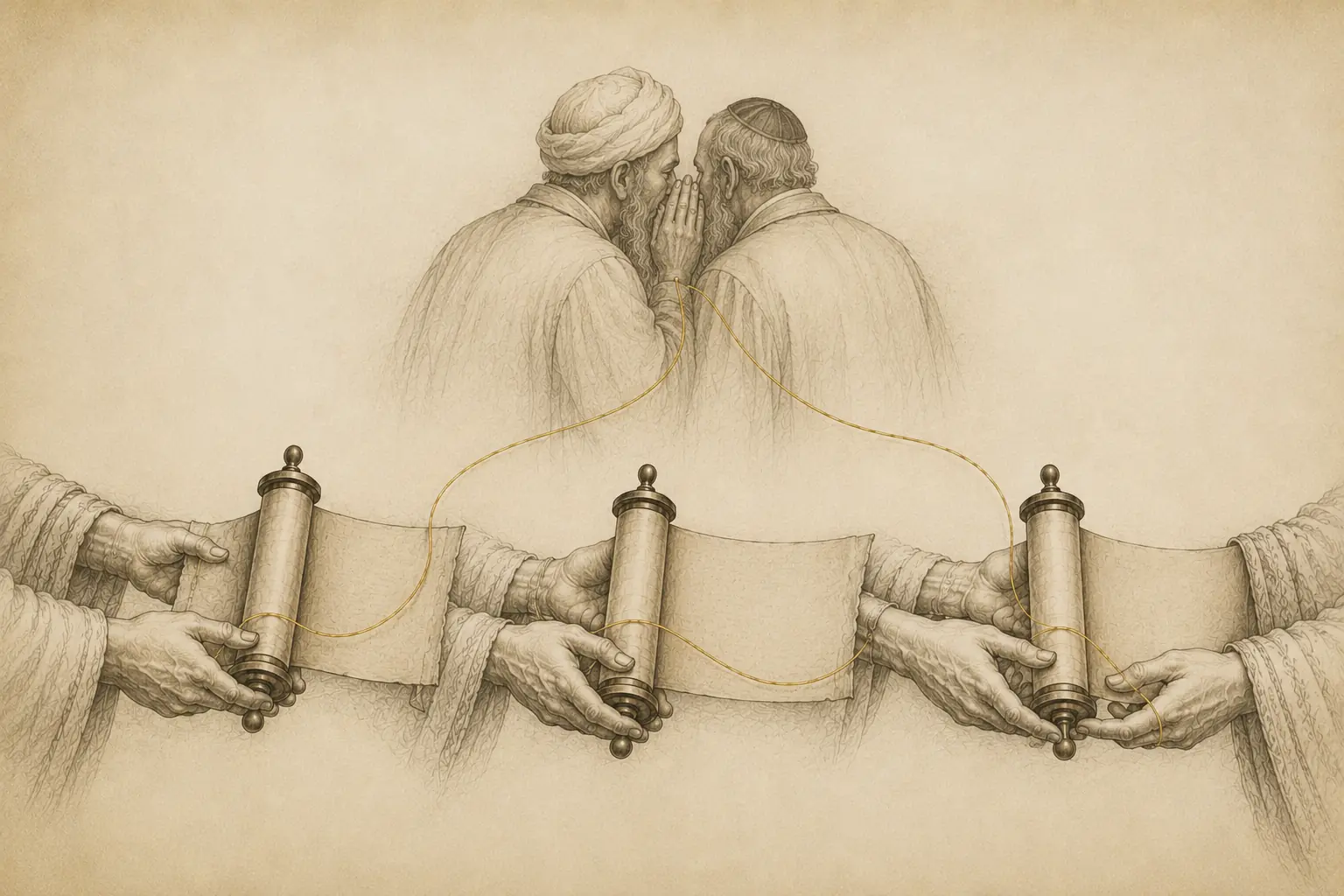
Direct answers on how Orthodox Judaism describes the movement of its teachings from Sinai forward.
What is the difference between the Written Torah and the Oral Torah?
The Written Torah is the fixed text of the covenant — the words themselves. The Oral Torah is the authoritative explanation needed to understand and practice it: definitions, procedures, the reasoning behind the law, and its deeper structure. Orthodox Judaism holds that both were given to Moses at Sinai as a single body of revelation in two inseparable forms.
The Talmud reads God's promise to give Moses "the tablets of stone, the Torah, and the commandment" as referring not only to a written text but to its explanation. Berakhot 5a; Exodus 24:12
Why was an oral explanation necessary at all?
Because many commandments cannot be carried out from the written words alone. The Torah commands the binding of tefillin, the writing of a mezuzah, Sabbath observance, and ritual slaughter without supplying every definition and procedure. The traditional answer is that the Written Torah was never intended to stand alone — its application was given together with it.
What is the chain of transmission from Sinai?
Pirkei Avot 1:1 gives the summary: Moses received the Torah at Sinai and transmitted it to Joshua; Joshua to the Elders; the Elders to the Prophets; and the Prophets to the Men of the Great Assembly. From there it continues through the Tannaim, who produced the Mishnah, the Amoraim, whose analysis became the Gemara, and Rav Ashi and Ravina, under whom the Babylonian Talmud approached completion.
Rambam gives a much fuller sequence in his introduction to the Mishneh Torah, naming the teachers through whom the tradition passed. The emphasis there falls on continuity rather than on individuals: every generation receives, studies, decides, and teaches.
When was the Oral Torah written down, and why?
As persecution, exile, and dispersion threatened the system of direct teaching, Rabbi Yehudah HaNasi organized the central teachings of the Oral Torah into the Mishnah. Later sages examined its language, sources, disagreements, and practical consequences, and those discussions became the Talmud — which has since formed the central framework of Jewish law and learning.
How many Torah scrolls did Moses write?
Rambam records that before his death Moses wrote thirteen Torah scrolls: one for each of the twelve tribes, and one kept beside the Ark as the national reference copy.
What are Ma'aseh Bereshit and Ma'aseh Merkavah?
They are the subjects under which rabbinic literature groups the tradition's teachings on creation and on the divine chariot — the inner account of how God relates to what He made. Mishnah Chagigah 2:1 restricts how they may be taught, on the grounds that they can be seriously misunderstood without preparation. This is why part of the tradition was carried with greater restriction rather than taught publicly.
Where do the Zohar, the Arizal, and Ramchal fit?
Within the traditional framework this project follows, works such as Sefer Yetzirah and the Zohar, the teachings of the Arizal, the systematic writings of Rabbi Moshe Chaim Luzzatto, and the teachings of the Chassidic masters belong to the inner dimension of Torah. They do not replace the Written or Oral Torah; they set out to disclose their deepest implications.
Does this account agree with academic scholarship on the Torah?
Not on the questions academic scholarship asks. This page presents the Orthodox Jewish account of its own tradition, which is the framework used throughout this website. Modern historical-critical scholarship asks different questions — about authorship, dating, redaction, and textual development — and may reach different conclusions. Stating the framework explicitly is meant to make clear what kind of claim is being made, rather than to blur the difference.