Step 01 — The Journey
Who is God?
Based on Orthodox Traditional Sources
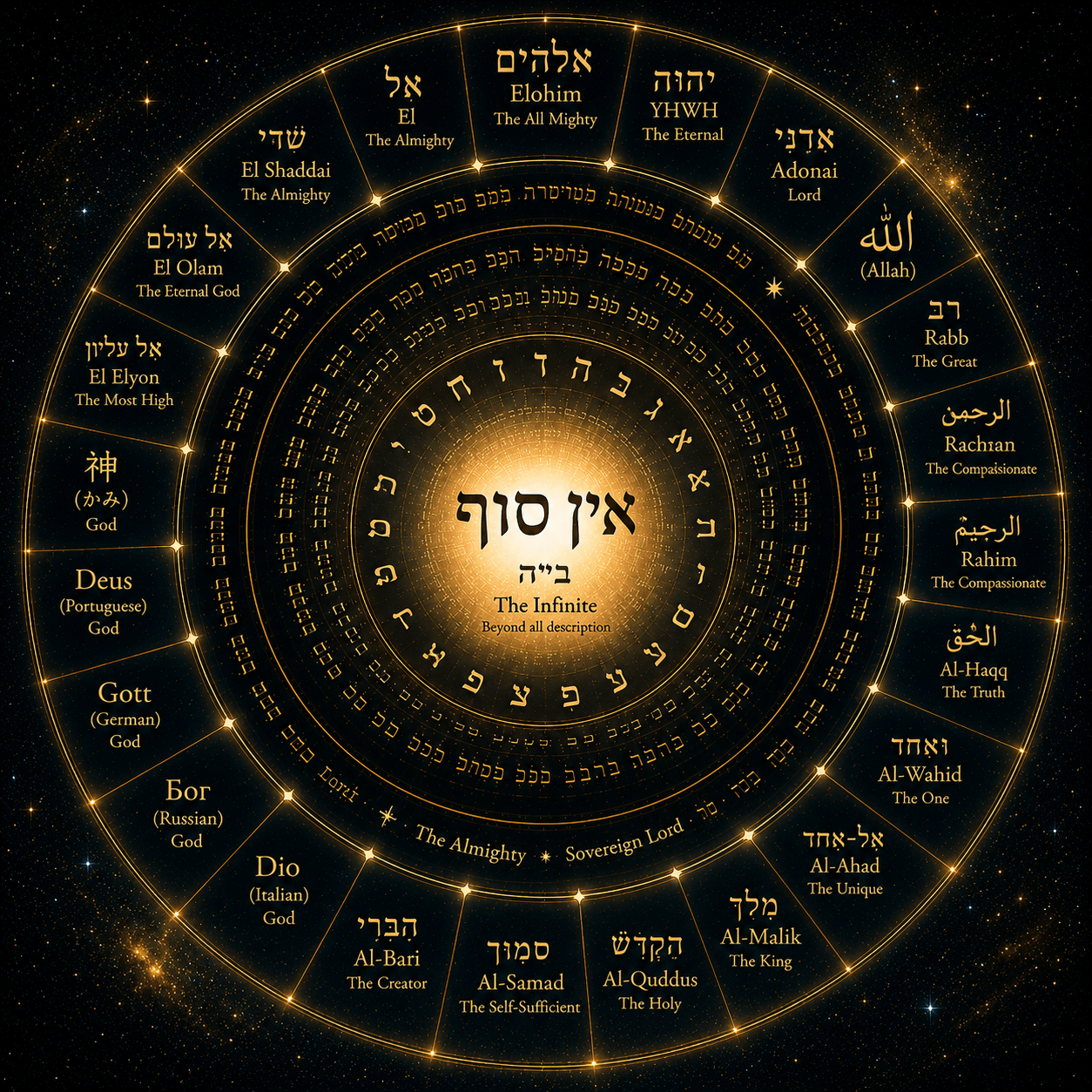
Many names. One infinite reality.
Step 01 — The Journey
Based on Orthodox Traditional Sources
Many names. One infinite reality.
This presentation is not going to tell you to believe in God. It is not going to ask you to think or feel anything in particular. It is going to present what Judaism says God is — precisely, honestly, and as far as human language can carry the idea.
Knowledge about God in Judaism is drawn from what was directly revealed by Him. The transmission begins with Adam — but it almost did not survive. In the generations that followed, humanity gradually drifted away from the knowledge of God, turning instead to direct their reverence toward finite powers — forces and beings that themselves depended on something greater for their existence. By the time of Avraham, the original knowledge had narrowed to a handful of individuals who kept it alive against the current of an entire civilization that had forgotten it.
Avraham changed that. He recovered and openly taught the knowledge of the one God, and what he carried was deepened and transmitted through Yitzchak, Yaakov, and the generations that followed.
At Mount Sinai, this knowledge reached its most complete and detailed form. Judaism understands that it then entered a national covenant and a defined chain of transmission: a Written Torah together with the Oral Torah that explains its meaning and application. Readers who want to understand how this website treats those sources can begin with How Were God’s Teachings Transmitted?
For a reason that will be explained later, the Holy One, blessed be He, concealed the revelation of His Divine Presence and placed His governance behind the veil of nature and the heavens. As a result, mankind no longer perceived God's actions directly, nor understood how He truly governs His world. Instead, people came to attribute events to nature itself and regarded natural forces as independent causes. They saw the mechanisms of the world but not the One who continuously sustains and directs them.
However, when the Holy One, blessed be He, desired to make Himself known at Sinai, He tore open the heavens and revealed His hidden treasure to the Jewish nation. They received not only commandments, but also certainty regarding all that God wished mankind to know about Him — and they faithfully transmitted this knowledge from generation to generation.
After Sinai, God continued to reveal Himself through the prophets, each one receiving new revelation on a specific dimension of that same truth. The kabbalists, in turn, transmitted the hidden inner logic of how God relates to the world He created.
This transmitted knowledge — preserved through the Torah, the prophets, the sages, and the Jewish tradition — is the source from which the following discussion draws its understanding of who God is.
Judaism distinguishes between two ways of knowing God: His Essence and His relationship with His creation. God's Essence refers to what He is in Himself, while His relationship with creation consists of the ways He chooses to reveal Himself through His governance of the world. Everything the Torah and the Jewish tradition teach about God belongs to one of these two categories.
Regarding God's Essence, Judaism allows us to affirm three fundamental truths. He truly exists, He is absolutely perfect, and His power is without limit. Together, these truths form the foundation of the Jewish understanding of God's Essence. We know them in two ways: through reason, which concludes that the First Cause cannot possess limitation or deficiency, and through Divine revelation, which confirms and further clarifies them. Even these truths, however, must not be understood according to human concepts. God's existence is not existence as we know it, His perfection is not perfection as we experience it, and His unlimited power is not power as we understand it. Rather, they affirm that no limitation or deficiency can apply to Him. Together, these three truths form the foundation of the Jewish understanding of God's Essence and will be presented step by step in the pages that follow.
Beyond these fundamental truths, God's Essence remains forever hidden. God neither revealed what He is in Himself nor created the human mind with the capacity to comprehend it. We can therefore know that He exists, but not what His Essence is.
God's relationship with His creation is different. Although His Essence remains hidden, God chose to reveal how He relates to the world. Through the Torah and the Jewish tradition, He made known His will, His governance, and the ways He acts toward His creatures. Thus, when the Torah speaks of God's wisdom, justice, mercy, kindness, kingship, or other attributes, it is not describing qualities that exist within His Essence. Rather, these are the names given to the different ways He chooses to act toward His creation. They teach us how God governs the world, not what He is in Himself.
The Written Torah records that God revealed Himself to the entire nation of Israel at Mount Sinai. The Oral Torah preserves additional explanations and teachings about this event through collections known as Midrashim (singular: Midrash). A Midrash is a traditional rabbinic exposition that expands upon the biblical text, conveying theological, moral, and spiritual insights preserved and transmitted by the Jewish Sages. The following passage from Midrash Aseret HaDiberot, in its exposition of the First Dibbur, presents one such traditional description of the revelation at Sinai:
When the Holy One, blessed be He, began to speak, the heavens above and the earth below trembled, and Israel could no longer stand upon their feet.
What did the Holy One, blessed be He, do? He sent to each and every Israelite two angels: one placed his hand upon the person’s heart so that his soul would not depart, and the other lifted up his head so that he could behold his Creator.
The Holy One granted them permission to gaze upon His Glory. They beheld His Glory, and they saw the Voice as it traveled and curved toward their ears.
The Midrash then describes how God first sought Israel’s acceptance of the Torah He was about to give them. After the people answered unanimously, “Yes! Yes!”, the Holy One, blessed be He, opened before them the seven heavens and the seven earths and proclaimed:
“See! You are My witnesses that there is none like Me in heaven or on earth. See that I alone am One, and that I have revealed Myself to you in My Glory and My Majesty…
Has any person ever seen his Creator in His Glory, His Splendor, and His Might, and then turned away from Him?”
Midrash Aseret HaDiberot — First Dibbur
Like many Midrashim, this passage uses vivid imagery to express the theological significance of the revelation at Sinai rather than to describe every detail literally. The references to God’s Glory, Splendor, and Might do not imply that Israel perceived His Essence, which remains forever beyond human comprehension. Rather, by “opening the heavens,” God temporarily lifted the veil that normally conceals His providence, allowing Israel to perceive with absolute clarity that every force of nature and every spiritual power is governed by His will alone.
This revelation permanently impressed upon Israel the certainty of God’s absolute sovereignty and marked the beginning of a unique covenant between God and His people. Through the Torah they were about to receive, God opened the path by which every generation can come to know His will more deeply and draw ever closer to Him.
Short answers to what readers most often ask about the Jewish understanding of God.
God is the First Cause of all existence: He truly exists, He is absolutely perfect, and His power is without limit. Judaism holds that these three affirmations are as far as human language can go about what God is in Himself, and that even they must not be understood in human terms — God's existence is not existence as we know it, and His perfection is not perfection as we experience it. What they establish is that no limitation or deficiency can apply to Him.
No. God has no body, no form, and no parts. When the Torah speaks of God's hand, His voice, or His anger, it is describing how His action is experienced from within creation, using the only language human beings have. Reading such expressions literally is precisely the error the distinction between essence and relationship is meant to prevent.
No. Judaism holds that God is absolutely simple, without components. Wisdom, justice, mercy, kindness, and kingship are the names given to the different ways He chooses to act toward His creation. They teach how God governs the world, not what He is in Himself, which is why the same unified will can appear as strict justice in one circumstance and as mercy in another.
From what God revealed, transmitted forward. The tradition traces the chain from Adam, describes how it narrowed almost to nothing as humanity turned to finite powers, and credits Avraham with recovering and openly teaching the knowledge of the one God. At Sinai it reached its most complete form and entered a national covenant with a defined chain of transmission — a Written Torah together with the Oral Torah that explains it. The prophets then received further revelation on particular dimensions of the same truth, and the kabbalists transmitted the inner logic of how God relates to the world.
For how that transmission works, see How were God's teachings transmitted?
No. According to the Oral Torah's account, what happened at Sinai was that God temporarily lifted the veil that normally conceals His providence, so that Israel perceived with complete clarity that every force of nature and every spiritual power is governed by His will alone. The Midrash's language of Glory, Splendor, and Might describes the certainty of that perception, not perception of the divine essence, which remains forever beyond a created mind.
Midrash Aseret HaDiberot, in its exposition of the First Dibbur, describes the heavens and the earth trembling when God began to speak, and Israel unable to remain standing. It relates that two angels were sent to each Israelite — one holding a hand on the person's heart so his soul would not depart, the other lifting his head so he could behold his Creator — and that the people saw the Voice as it traveled and curved toward their ears. God then opened the seven heavens and the seven earths and declared that there is none like Him in heaven or on earth.
Like many Midrashim, the passage uses vivid imagery to convey the theological weight of the event rather than to report every detail literally.